So you’ve decided you want in on the pharma business. Good move — it’s one of the few sectors that doesn’t slow down, recession or not. But now you’re stuck at a fork in the road: PCD pharma franchise or third-party manufacturing?
Everyone’s got an opinion. Your cousin who “knows someone in pharma” says one thing. That Facebook group says another. And honestly, most of what’s online just repeats the same textbook definitions without telling you what actually matters for your pocket and your plans.
We’ve sat across the table with hundreds of people asking this exact question. So let’s skip the fluff and get into it — PCD vs third-party manufacturing, explained the way we’d explain it to a friend over chai.
What Is a PCD Pharma Franchise, Really?
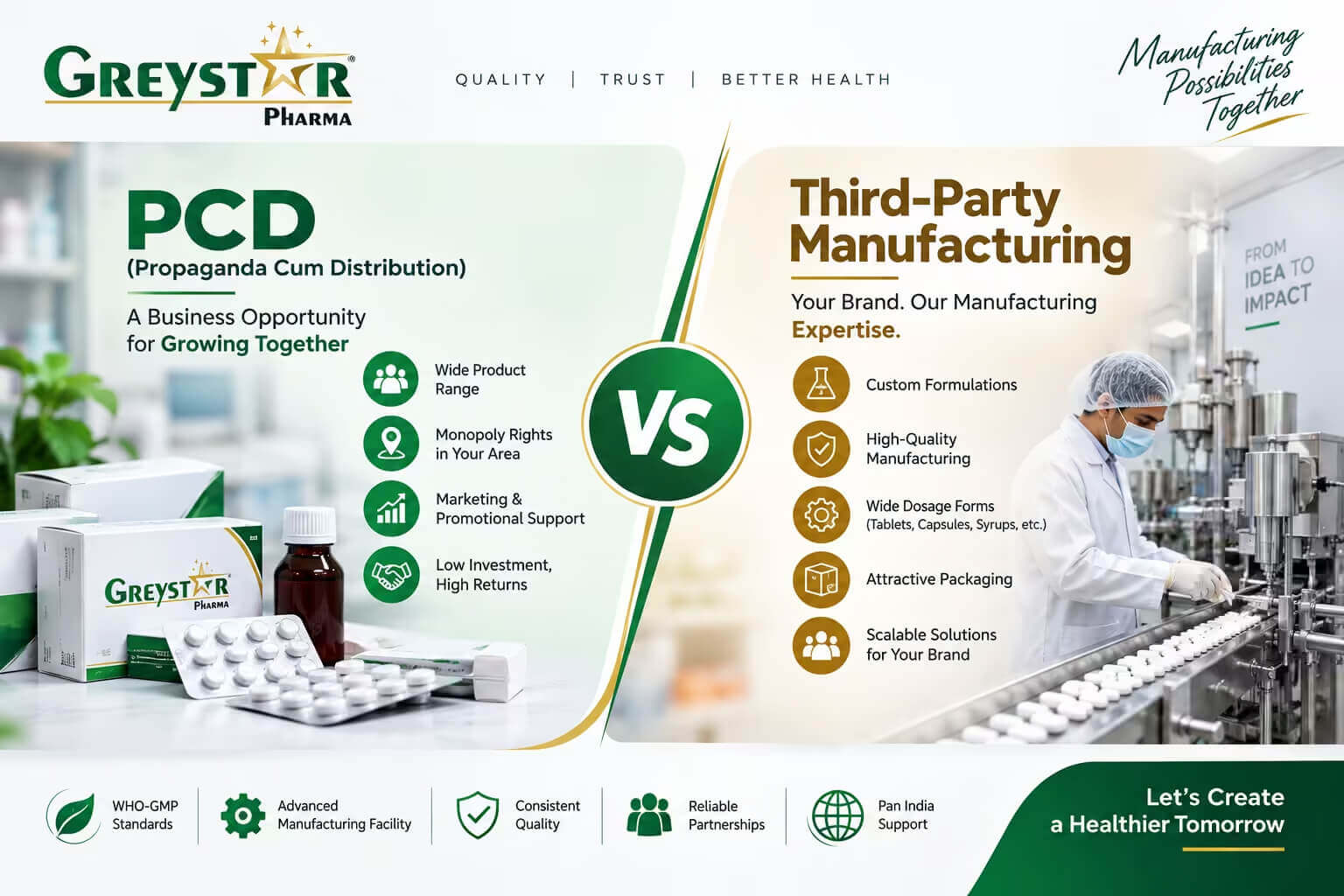
PCD stands for Propaganda Cum Distribution. Sounds a bit dramatic, but all it means is this: a pharma company like Greystar Pharma hands you the right to sell its already-made products in your area. You get the brand name, the product range, the marketing material — banners, visual aids, MR bags, sample strips, all of it. Your job is simple: build relationships with doctors and chemists and move the stock.
You don’t manufacture anything. You don’t need a drug manufacturing licence. You just need a wholesale/retail drug licence (or sometimes not even that, depending on the state and business structure), some working capital, and the will to hustle in your territory.
This is why so many first-time entrepreneurs, medical reps, and small distributors start here. It’s low-risk and low-barrier, and the parent company has already done the hard part — R&D, formulation, quality testing, and manufacturing.
What Is Third-Party Manufacturing?
Now flip it. In third-party manufacturing, you’re the brand owner. You come up with your own company name, your own product packaging, and maybe your own product line. But you don’t own a factory. Instead, you hire a WHO-GMP-certified manufacturer to produce the medicines for you, under your label.
You handle the marketing, the sales, the branding, and the growth strategy. The manufacturer handles production, batch testing, and compliance on the manufacturing side. You get more freedom — you can add products, change packaging, tweak your formulations (within regulatory limits) — but you also carry more responsibility.
Think of it like this: PCD is renting a house. Third-party manufacturing is building your own house on land someone else prepared for you.
PCD Pharma Franchise Investment vs Third-Party Manufacturing Cost
This is usually the first question people ask, and fair enough — money decides everything.
| Factor | PCD Pharma Franchise | Third-Party Manufacturing |
| Starting investment | ₹25,000 – ₹1,00,000 (varies by company and product range) | ₹1,00,000 – ₹5,00,000+ (depends on order quantity, packaging, branding) |
| Minimum order quantity | Usually low or flexible | Higher MOQ per batch |
| License needed | Wholesale/retail drug licence | A drug manufacturing licence is not needed, but you need your own trade licence and sometimes a marketing licence depending on state rules. |
| Brand ownership cost | None — you use a parent brand. | You bear the full branding, design, and registration cost. |
| Ongoing cost | Stock purchase + local marketing | Bulk stock orders + packaging + your own marketing |
| Break-even time | Faster, usually within months | Slower, since you’re building a brand from scratch |
Here’s the honest bit: PCD costs less upfront because you’re piggybacking on an existing brand. Third-party manufacturing costs more because you’re building something that’s entirely yours — and that something can be sold, scaled, or even franchised out later. One’s a lower entry cost with a ceiling. The other’s a higher entry cost with more room to grow.
PCD Pharma Franchise vs Third-Party Manufacturing: Which Is Better?
We get this question at least a few times a week. And honestly? There’s no single right answer. It depends entirely on what you want out of this business. Let’s break it down by what actually matters to you.
Pick PCD pharma franchise if:
You want to start fast, with less paperwork and lower investment.
You’re new to pharma and want to learn the ropes before going bigger
You value monopoly rights in your territory over building your own brand
You want marketing support and ready-made promotional material
You’d rather focus purely on sales and relationships, not operations
Pick third-party manufacturing if:
You already have some pharma market experience or an existing customer base
You want your own brand name and long-term brand value
You want full control over product range, packaging, and pricing
You’re okay with higher order quantities and more upfront investment
You’re building this as a company you might scale, sell, or hand down — not just run
A lot of successful pharma entrepreneurs actually start with PCD, build capital and market understanding, then move into third-party manufacturing once they’re ready to own a brand. There’s no shame in starting small. In fact, it’s usually the smarter path.
Control, Risk, and Profit Margins — The Part Nobody Explains Properly
Let’s talk numbers and control, because this is where the real difference shows up.
Control: In PCD, you have zero control over formulations, pricing structure, or product changes. The parent company decides. In third-party manufacturing, you can request formulation tweaks, choose your own packaging design, and set your own MRP within market limits.
Risk: PCD carries lower risk because you’re not holding a brand’s reputation — if a batch has an issue, it’s the parent company’s problem to fix, though obviously it still affects your local sales. In third-party manufacturing, quality issues land on your brand directly. You need to vet your manufacturer carefully — check their WHO-GMP, GLP, and ISO certifications before signing anything.
Profit margins: This one surprises people. Margins in third-party manufacturing are usually higher per unit because you’re not paying a franchise markup — you’re buying at manufacturing cost and selling at brand price. PCD margins are decent but capped, since the parent company has already priced in its own profit before it reaches you.
A Real Example (Without the Fluff)
We’ve worked with distributors who started as PCD partners with a cardiac and diabetic product range — small territory, low investment, steady monthly orders. Eighteen months in, once they understood demand patterns and built doctor relationships, they moved into third-party manufacturing for a soft gel and nutraceutical line under their own brand name. Their margins nearly doubled, but so did their workload — packaging decisions, compliance paperwork, bigger stock commitments.
That’s the trade-off in a nutshell. More control and profit always comes with more responsibility. Nobody hands you higher margins for free.
Common Mistakes People Make Choosing Between the Two
Jumping into third-party manufacturing without enough working capital for the first few months of slow sales
Choosing a PCD company without checking if they actually offer monopoly rights (some just say it, don’t assume — ask for it in writing)
Not verifying manufacturer certifications before committing to third-party production
Underestimating how much marketing effort third-party brands need compared to PCD, where promotional material is already provided
Picking a model based on what a friend did, instead of what fits their own budget and goals
How Greystar Pharma Fits Into This
At Greystar Pharma, we run a straightforward PCD pharma franchise model across therapeutic segments — cardiac and diabetic care, injectables, eye care through our Blinkvision division, skin care through Brightderm, fertility support via Maxfertovia, and ayurvedic wellness through Oakard Ayurveda.
If you’re leaning toward PCD because you want a lower-risk entry with monopoly rights and real marketing support, our PCD Pharma Franchise page walks through exactly what’s included — product range, territory terms, and how fast you can get started. You can also browse our full product range to see what fits your target market.
Not sure yet? That’s fine too. Get in touch with our team and we’ll walk you through what makes sense for your budget and your city, without any sales pressure.
Frequently asked questions FAQs
1. PCD pharma franchise is profitable in 2026?
Yes, especially in Tier 2 and Tier 3 cities, where demand is on the rise and competition among franchise partners is still manageable.
2. Is it possible to switch from PCD to third party manufacturing later?
Of course. Many distributors will start out with PCD to learn the market and then move into third party manufacturing when they have the capital and confidence.
3. Which one involves a larger investment – PCD or Third party manufacturing?
Third-party manufacturing typically requires more capital initially due to higher minimum order quantities and branding costs.
4. Do I need a manufacturing license for manufacturing by third parties?
No. The manufacturing licence is held by your manufacturer. You only need your own trading and marketing setup.
5. What are monopoly rights in the PCD franchise?
It means the parent company gives you the exclusive right to sell their products in a particular territory so that there is no competition from other franchise partners in that territory.
6. Is PCD pharma franchise a good business for freshers?
Yes it is one of the simplest entry points into pharma for people that have no previous business experience. The parent company provides the products, marketing tools and guidance.
7. How much time does it take to break even in the PCD pharma franchise?
Most partners see returns in 4 to 8 months depending on territory size and how aggressively they build doctor relationships.
8. Can I start my own pharma brand through third-party manufacturing?
Yes, in fact that’s its biggest benefit – full brand ownership without the expense of setting up your own factory.
9. What certifications should I check for when selecting a third-party manufacturer?
Look for certifications like WHO-GMP, GLP and ISO, as well as their track record and client list.
10. PCD Or Third Party Manufacturing Which Model Is More Profitable?
Third party manufacturing generally has higher per unit margins as there is no franchise markup, but more operational responsibility.
11. Is PCD and third party manufacturing offered by Greystar Pharma?
Greystar Pharma is a PCD Pharma Franchise company with monopoly rights and marketing support. Contact us for the latest details on our offerings through our contact page.