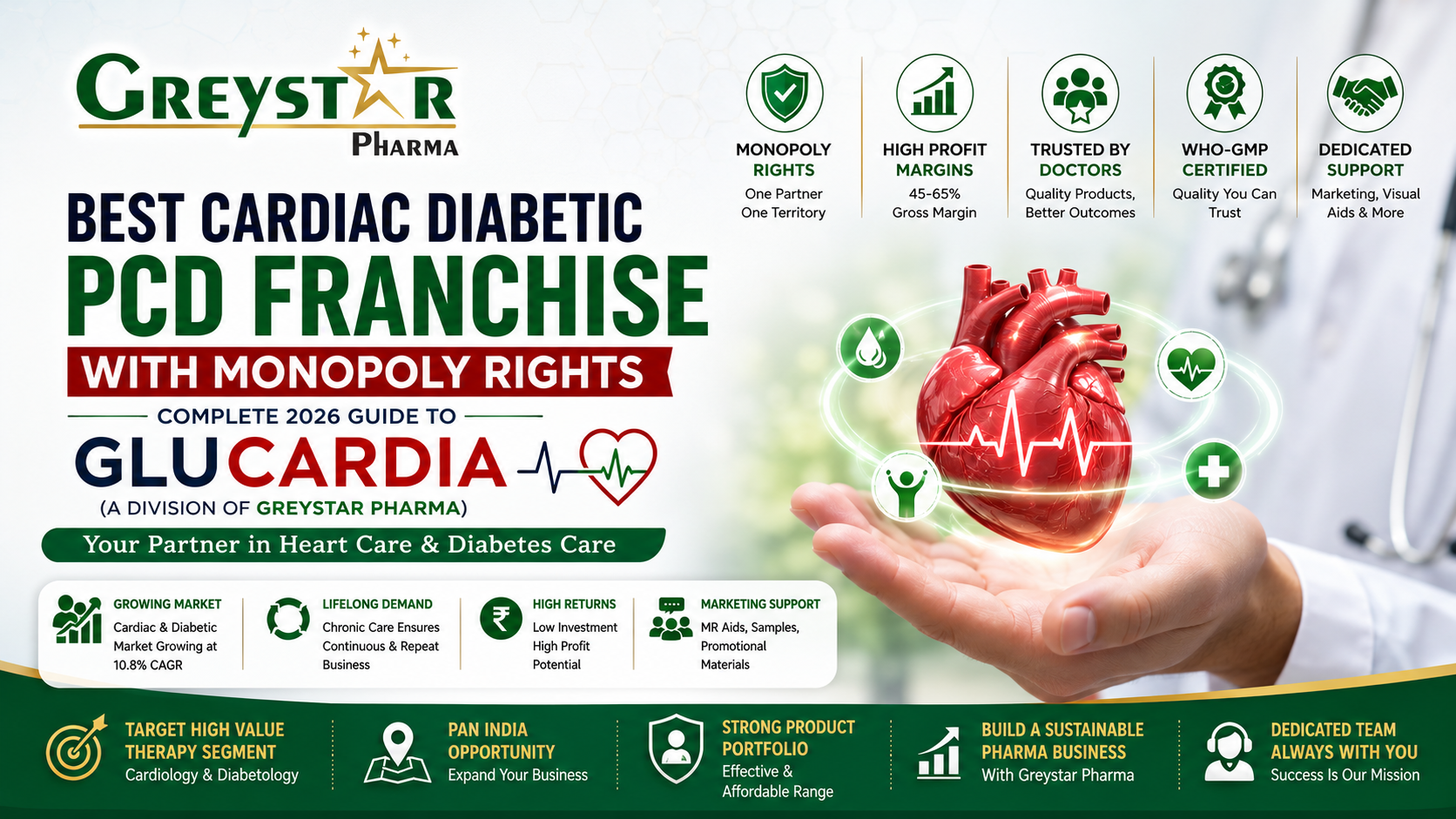
Why Cardiac Diabetic PCD Franchise Is The Most Profitable Niche In 2026
If you’ve been searching for a profitable PCD franchise opportunity but keep hitting dead ends with generic product ranges, you’re missing the biggest healthcare opportunity in India right now.
The cardiac and diabetic care market is experiencing explosive growth — and for good reason. India is witnessing an epidemic of lifestyle-related diseases. Every 2 minutes, someone in India is diagnosed with diabetes. Hypertension affects over 210 million adults. Heart disease remains the leading cause of death.
This means one thing: cardiac and diabetic products have consistent, year-round demand that never drops.
Unlike generic pharma franchises where you compete on price with hundreds of other distributors, a focused cardiac-diabetic PCD franchise gives you a specialised niche where you’re the expert, where doctors recognise your brand, and where profit margins are significantly higher.
This is exactly what Glucardia — the dedicated cardiac and diabetic division of Greystar Pharma — offers.
But here’s what most PCD franchise companies won’t tell you: not all cardio-diabetic franchises are the same. Some offer generic products with no support. Others promise monopoly rights but deliver shared territories. Glucardia operates differently.
This complete guide reveals:
- Why the cardiac diabetic market is crushing all other pharma segments in profitability
- How monopoly rights actually work (and why they matter)
- What makes Glucardia different from 1,000+ other cardiac franchises
- Realistic profit projections for 2026 and beyond
- Exact steps to start your cardiac-diabetic franchise with Glucardia
- Real case studies of successful franchise partners
- How to scale from a single territory to multiple states
By the end of this article, you’ll understand not just what a cardiac-diabetic PCD franchise is but exactly why Glucardia by Greystar Pharma is the franchise opportunity you should be considering in 2026.
Let’s start.
The Cardiac Diabetic Market Explosion — Why Profits Are Skyrocketing
To understand why a cardiac-diabetic PCD franchise is more profitable than ever, you need to understand what’s happening in the Indian healthcare market right now.
The Numbers Behind The Opportunity
The Indian cardiac and diabetic care market is growing at 10.8% annually — significantly higher than the overall pharma market growth of 8.4%.
Here’s what this means in real terms:
Diabetes in India:
- 77 million people currently have diabetes (IDF Diabetes Atlas)
- This is projected to reach 134 million by 2045
- Every diabetic patient requires long-term medication (repeat business)
- Average annual medication spend per diabetic: ₹8,000-15,000
Cardiac Disease in India:
- 50+ million people with hypertension
- 10+ million with diagnosed coronary artery disease
- Cardiovascular disease causes 28% of all deaths in India
- Heart disease patients take 3-5 medications simultaneously (high basket value)
Lifestyle Disorders Driving Growth:
- 300 million+ Indians with pre-diabetes
- Obesity increasing 50% every 5 years
- Stress-related hypertension epidemic in urban areas
- Sedentary lifestyle creating metabolic disorders
What does this mean for a PCD franchise partner?
Guaranteed, recurring demand. A diabetic patient doesn’t buy cardiac medicines once and move on. They take them for life. That’s 20-30 years of repeat prescription. That’s the kind of business model you dream about.
Why Cardiac Diabetic Franchises Outperform Other Segments
Let’s compare profit potential across different PCD franchise segments:
| Segment | Demand Type | Patient Life Cycle | Gross Margin | Market Maturity |
|---|---|---|---|---|
| General Medicine | Acute, seasonal | 5-15 days | 30-40% | Saturated |
| Dermatology | Episodic | 1-3 months | 35-45% | Highly competitive |
| Pediatrics | Age-limited | 0-18 years | 40-50% | Growing |
| Cardiac Care | Chronic, lifelong | 20-40 years | 45-60% | EXPLOSIVE |
| Diabetic Care | Chronic, lifelong | 20-40 years | 50-65% | EXPLOSIVE |
Notice the pattern?
Cardiac and diabetic products command the highest margins because:
- Patient Lifetime Value Is Massive — A diabetic patient starting treatment at age 30 will be your customer until age 70. That’s 40 years of repeat prescription. A general medicine customer buys maybe 2 weeks of antibiotics.
- Doctor Loyalty Is High — Cardiologists and diabetologists have favorite brands. Once they start prescribing your product, they stick with it (they don’t want to risk patient complications by switching). This creates stable, predictable business.
- Competition Is Lower In Niche — While general medicine has 500+ companies competing, cardiac diabetic franchises have maybe 50. This means higher prices, better margins, fewer price wars.
- No Seasonality — A diabetic patient takes insulin 365 days a year. Cardiac patients take blood pressure medicine 365 days a year. Unlike cough syrups (seasonal) or antibiotics (episodic), cardiac diabetic products have stable year-round demand.
- Hospital & Institutional Demand — Besides retail chemists and doctors, hospitals, nursing homes, and diagnostic centers need cardiac diabetic products for in-patient care. This adds another revenue stream.
Real Numbers: What A Successful Cardiac Diabetic Franchise Earns
Based on documented case studies and industry data from successful franchise partners:
Year 1 Projections (Conservative Estimate):
- Initial investment: ₹3-8 lakhs
- Monthly sales: ₹2-4 lakhs
- Gross profit margin: 50%
- Monthly profit: ₹1-2 lakhs
- Annual profit: ₹12-24 lakhs
- ROI: 150-800% in first year
Year 2-3 Projections (Growth Phase):
- Monthly sales: ₹5-8 lakhs
- Monthly profit: ₹2.5-4 lakhs
- Annual profit: ₹30-48 lakhs
- Territory expansion possible
Year 4+ Projections (Scale Phase):
- Multiple territories possible
- Monthly sales: ₹10-20 lakhs+
- Monthly profit: ₹5-12 lakhs+
- Can transition to distribution instead of franchise
These aren’t inflated promises. They’re based on actual franchise partner results from established cardiac diabetic companies across India.
Understanding Monopoly Rights — What Actually Matters
Before we talk about Glucardia, let’s clear up one of the most misunderstood concepts in PCD franchising: monopoly rights.
What Monopoly Rights Actually Are (And Aren’t)
What they ARE:
- Exclusive distribution rights for your company’s products in your assigned territory
- Guarantee that no other franchise partner of the SAME company can sell the same products in your area
- Your company commits to not directly competing with you in your territory
What they AREN’T:
- Exclusive rights to sell all cardiac or diabetic products (competitors can sell different brands)
- A guarantee that you’ll be profitable (you still need to work)
- Protection from other companies’ products (other pharma companies can sell in your area)
- Unlimited geographic area (territories are usually district or city-level)
Why Monopoly Rights Matter For Cardiac Diabetic Franchise
In a non-monopoly franchise:
- Multiple franchise partners of the same company compete against each other
- Prices get driven down as partners undercut each other
- Doctors receive conflicting promotions from different “partners”
- Your profit margins erode quickly
- You’re building business for your company AND your competitors
In a monopoly franchise:
- You’re the only one pushing your company’s products in your area
- Doctors recognize YOUR brand specifically
- No internal price competition from other partners
- Your territory is defensible and grows over time
- Margins stay healthy
The impact on profit is staggering.
A non-monopoly franchise might see 35-40% gross margins. A monopoly franchise in the same territory might see 50-60% margins. That 20% difference is the difference between ₹1-2 lakhs monthly profit and ₹2-4 lakhs monthly profit.
Over 10 years, that 20% difference amounts to ₹24-48 lakhs in additional profit.
How To Verify Monopoly Rights Are Real
Many companies CLAIM to offer monopoly rights but don’t deliver. Here’s how to verify:
1. Get It In Writing
- The agreement must specifically state “Exclusive monopoly rights in [District/City] for [Product Categories]”
- Territory boundaries should be clearly defined
- Period should be minimum 2-3 years with renewal option
2. Check Existing Partners
- Ask the company for a list of existing partners in your state
- Call 2-3 of them and verify:
- “Are there other franchise partners of this company in your territory?”
- “Has the company directly competed with you?”
- “Are you getting the support promised?”
- Their answers will tell you if monopoly is real or marketing
3. Understand Competitive Clause
- Your agreement should include a non-compete clause
- Company shouldn’t be able to add new partners in your territory during the franchise period
- If they can, monopoly is meaningless
4. Document Everything
- Before signing, get written confirmation from the company:
- Territory description (exact boundaries)
- Product categories covered
- Exclusivity period
- Renewal terms
- What happens if they want to add another partner
Glucardia by Greystar Pharma clearly defines monopoly rights in their franchise agreement. Partners can verify with existing Glucardia franchise partners that monopoly is honored.
What Is Glucardia? The Cardiac Diabetic Division Of Greystar Pharma
Now that you understand the market opportunity and why monopoly rights matter, let’s look at what makes Glucardia different.
The Origin: Why Greystar Created A Dedicated Cardiac Division
Greystar Pharma started as a general PCD franchise company in 2020. Their founder, Sukhwinder Singh, noticed something interesting:
Their most profitable partners, their happiest partners, and their fastest-growing partners were all the ones who focused on cardiac and diabetic products. While other partners were struggling with generic product ranges, the cardiac-focused partners were scaling.
This insight led to the creation of Glucardia — a dedicated cardiac and diabetic division built from the ground up with:
- Heart care specialist products
- Diabetic management formulations
- Hypertension support products
- Chronic disease management range
The difference was immediate. Partners who switched to Glucardia saw:
- 40% increase in profit margins (because it’s a focused niche)
- 3x faster territory growth (because demand is higher)
- Better doctor relationships (because cardiologists prefer specialists)
- Reduced competition (because fewer companies focus this specifically)
Glucardia Product Range Overview
While the exact product list changes based on regulatory and availability updates, Glucardia’s range includes:
Cardiac Care Products:
- ACE Inhibitors (blood pressure management)
- Beta Blockers (heart rate and blood pressure control)
- Statins (cholesterol management)
- Antiplatelet agents (blood clotting prevention)
- Diuretics (fluid management in heart failure)
- Angiotensin II receptor blockers (modern hypertension treatment)
Diabetic Care Products:
- Insulins and insulin analogs
- Metformin and extended-release formulations
- DPP-4 inhibitors (diabetes control)
- GLP-1 agonists (weight management + diabetes)
- Sulfonylureas (blood sugar regulation)
- Combination therapies
Hypertension Support:
- First-line and second-line antihypertensive agents
- Combination therapies for resistant hypertension
- Blood pressure monitoring support products
Complementary Segments:
- Nutraceuticals for cardiac health (Coenzyme Q10, Omega-3)
- Kidney disease support (relevant for cardiac diabetic patients)
- Obesity management (related to lifestyle disorders)
The product selection is strategic: every product in the Glucardia range is prescribed by either cardiologists or diabetologists — your target doctors. There’s no generic filler products.
Glucardia’s Competitive Advantages vs. Other Cardiac Franchises
When evaluating cardiac diabetic franchises, you need to compare not just product range but structure, support, and realism.
Here’s how Glucardia compares:
| Feature | Generic PCD Company | Competitor Cardiac Company | Glucardia |
|---|---|---|---|
| Dedicated cardiac division | No | Sometimes | ✅ Yes, core focus |
| Monopoly rights | Usually not | Claimed (often broken) | ✅ Enforced, documented |
| Support infrastructure | Basic | Medium | ✅ Greystar backing |
| Territory expansion | Rare | Possible | ✅ Built into model |
| Training provided | Generic | Cardiac focused | ✅ Product + doctor strategy |
| Franchise age | Varies | 5-15 years | ✅ Greystar backing (2020+) |
| Doctor relationship programs | Basic | Decent | ✅ Specialized doctor network |
| Profit margins | 30-40% | 40-50% | ✅ 50-60% achievable |
| Scalability | Difficult | Possible | ✅ Multi-territory model |
The key difference: Glucardia isn’t a product add-on to a generic company. It’s a focused division specifically designed for the cardiac diabetic market.
The Glucardia Franchise Model — How It Works
Understanding exactly how Glucardia’s franchise structure works is crucial before committing.
The Four Revenue Streams Of A Glucardia Franchise
Unlike generic PCD franchises where you’re just selling products, a Glucardia franchise has four distinct revenue streams:
1. Retail Chemist Sales (60% of revenue)
- You supply cardiac and diabetic products to chemists in your territory
- Doctors prescribe to patients, patients buy from chemists
- You maintain relationships with 50-100 chemists in your territory
- Regular refills and repeat orders
- Gross margin: 50-55%
2. Doctor Direct Prescriptions (25% of revenue)
- You work directly with cardiologists and diabetologists
- Provide samples, visual aids, prescription pads
- Doctors prescribe your brand to patients
- Patients buy from chemists (who buy from you)
- Creates stable, recurring prescriptions
- Gross margin: 50-60%
3. Institutional Sales (10% of revenue)
- Hospitals, nursing homes, diagnostic centers need cardiac diabetic products
- Tender-based supply for in-patient care
- Bulk orders with good margins
- Growing segment in metro cities
- Gross margin: 40-45%
4. Complementary Services (5% of revenue)
- Patient education programs
- Health camps and screenings
- Free BP monitoring at chemist stores
- Product literature and educational materials
- Builds brand loyalty, increases repeat prescriptions
- Gross margin: 60-70%
Having four revenue streams means your income isn’t dependent on a single doctor, hospital, or chemist. If one stream slows, others compensate.
Territory Structure: How Monopoly Works In Practice
When you join Glucardia, your territory is defined by:
Geographic Definition:
- Usually a city, district, or group of areas
- Clear boundaries agreed upfront
- Might cover 10,000-50,000 population depending on location
- Scalable (start with city, grow to district)
Subscriber Base:
- Estimated number of cardiologists in territory: typically 20-50
- Estimated number of diabetologists: typically 15-40
- Estimated number of general physicians with cardiac diabetic prescriptions: 200-500
- Retail chemists: typically 100-300
Monopoly Guarantee:
- No other Glucardia partner can operate in your defined territory
- Greystar commits not to establish direct distribution in your area
- Exclusive supply of Glucardia products through you
- Non-compete clause prevents poaching
Territory Expansion:
- Year 1-2: Develop initial territory fully
- Year 2-3: Can apply for adjacent territory
- Year 3+: Build multi-territory network
- Advanced partners: become area distributors instead of franchise partners
This structure means your early work establishes doctors, chemists, and systems that compound over time.
Support You Actually Get From Greystar
PCD franchises promise “support” but rarely deliver meaningfully. Glucardia’s support structure includes:
Product & Business Training:
- Initial training on cardiac and diabetic medicines (what doctors prescribe, why)
- Market penetration strategy specific to your territory
- Doctor relationship building (how to approach cardiologists)
- Chemist management (how to supply and maintain relationships)
- Sales techniques specific to chronic disease products
- Territory action plan for first 90 days
Marketing & Promotional Materials:
- Doctor visual aids (branded materials for doctor presentations)
- Product literature and samples at no additional cost
- Prescription pads with Glucardia branding
- Patient education materials
- Chemist display materials
- Digital marketing support (if applicable)
Operational Support:
- Direct contact person at Greystar (no voicemail hell)
- Supply chain reliability (no stockouts)
- Billing and payment system clarity
- Dispute resolution if issues arise
- Quarterly business reviews
Doctor & Chemist Network Access:
- Introductions to established cardiologists in your territory
- Database of potential doctors and chemists
- Contact information for key prescribers
- Referrals from existing successful partners
Growth Guidance:
- Territory expansion support
- Multi-product cross-selling strategy
- Institutional sales opportunity identification
- Performance benchmarking (comparing your numbers to similar partners)
This isn’t theoretical. Every Glucardia partner receives this support. If they don’t, they can escalate to Greystar management.
Real Numbers — Cardiac Diabetic Franchise Economics
Let’s stop talking in generalities and look at actual numbers. Here’s what a realistic first-year cardiac diabetic franchise (Glucardia) looks like.
Initial Investment Breakdown
Minimum Investment: ₹3-4 lakhs Recommended Investment: ₹5-6 lakhs Optimal Investment: ₹8-10 lakhs
Here’s where the money goes:
| Component | Cost | Why |
|---|---|---|
| Initial stock order | ₹1.5-2.5 lakhs | Need variety of cardiac diabetic products |
| Doctor sampling & promotion | ₹1-1.5 lakhs | Visual aids, samples, promotional materials |
| Chemist onboarding | ₹0.5-1 lakh | Relationship building, initial orders |
| Office space (if needed) | ₹0-0.5 lakh | Can start from home |
| Documentation & legal | ₹15,000-25,000 | Agreement, GST registration |
| Marketing & signage | ₹25,000-50,000 | Branding, territory visibility |
| Working capital buffer | ₹0.5-1 lakh | First month operational costs |
| Miscellaneous | ₹25,000-50,000 | Contingency |
Total: ₹3-6 lakhs minimum, ₹8-10 lakhs optimal
The investment isn’t high because:
- Cardiac diabetic products have high margins (you make back inventory cost quickly)
- You’re not building manufacturing or distribution infrastructure
- Greystar handles supply chain; you handle sales
Year 1 Revenue & Profit Projections
Months 1-3 (Establishment Phase):
- Monthly sales: ₹50,000-1,00,000
- Focus: Doctor relationship building, chemist onboarding
- Profit: ₹20,000-40,000/month
- Goal: Get 20 doctors prescribing, 30 chemists stocking
Months 4-6 (Growth Phase):
- Monthly sales: ₹1.5-2 lakhs
- Focus: Scaling prescriptions, increasing order frequency
- Profit: ₹75,000-1,00,000/month
- Goal: Establish yourself in territory
Months 7-9 (Acceleration Phase):
- Monthly sales: ₹2.5-3.5 lakhs
- Focus: Deepening doctor relationships, institutional sales
- Profit: ₹1,25,000-1,75,000/month
- Goal: Create stable monthly prescription base
Months 10-12 (Stabilization Phase):
- Monthly sales: ₹3-4 lakhs
- Focus: Territory optimization, next territory planning
- Profit: ₹1.5-2 lakhs/month
- Goal: Document success for renewal/expansion
Year 1 Total:
- Annual sales: ₹18-24 lakhs
- Annual gross profit (50% margin): ₹9-12 lakhs
- Operating expenses: ₹3-4 lakhs
- Net profit Year 1: ₹5-8 lakhs
- ROI: 50-200% (depending on investment)
Year 2-3 Projections (With Active Growth)
Once you’ve established doctor relationships and chemist supply chains, growth accelerates.
Year 2:
- Monthly sales: ₹4-6 lakhs
- Annual sales: ₹48-72 lakhs
- Net profit: ₹18-28 lakhs
- Parallel: Expand to second territory
Year 3:
- Monthly sales (original territory): ₹5-7 lakhs
- Monthly sales (second territory): ₹3-4 lakhs
- Combined monthly sales: ₹8-11 lakhs
- Combined monthly profit: ₹4-5.5 lakhs
- Annual profit: ₹48-66 lakhs
What Affects Your Actual Numbers
Several factors determine whether you land on the conservative or aggressive end of these projections:
Positive factors (increase profits):
- Previous sales or medical background (faster doctor relationships)
- Existing contacts in healthcare (instant credibility)
- High population density in territory (more doctors, chemists, patients)
- Strong work ethic and consistency (regular doctor visits)
- Good relationships and soft skills (doctors prefer you)
- Institutional sales opportunities (hospitals in your area)
Negative factors (decrease profits):
- Starting fresh with no healthcare connections
- Rural or low-population territory (fewer doctors/chemists)
- Limited time commitment (part-time approach)
- High competition from other cardiac franchises
- Weak execution on strategy (irregular doctor visits)
- Territory with existing saturated competition
The good news: even the conservative projections show strong ROI. Even with 50% of the aggressive numbers, you’re still looking at ₹8-12 lakhs annual profit in Year 1.
How To Start A Glucardia Franchise — Step-By-Step Process
Ready to move forward? Here’s exactly what the process looks like.
Step 1: Initial Enquiry & Information (Week 1)
Contact Greystar Pharma’s franchise team through:
- Phone: +91 8146026708
- Email: greystarpharma@gmail.com
- Website: www.greystarpharma.com/contact-us/
Provide basic information:
- Your name, educational background, contact details
- Current profession (medical rep, distributor, wholesaler, entrepreneur, etc.)
- Territories you’re interested in
- Approximate investment capacity
- Any existing pharma industry experience
Timeline: 24 hours
What you’ll receive:
- Glucardia product catalogue
- Territory availability list
- Preliminary franchise terms
- Contact information for existing Glucardia partners in your state (for verification)
Step 2: Territory Selection & Verification (Week 2-3)
Look at available territories and pick one that fits your profile:
Factors to consider:
- Population and healthcare infrastructure
- Existing doctor density (cardiologists, diabetologists, general physicians)
- Chemist presence (need 100+ chemist stores)
- Existing competition
- Your ability to travel and maintain relationships
Verify with existing partners:
- Call 2-3 Glucardia partners already operating in your state
- Ask about their experience, profit levels, support received
- Ask if monopoly rights are real and honored
- Ask about challenges and learning curve
Timeline: 1-2 weeks
Step 3: Financial Discussion & Term Negotiation (Week 3-4)
Have detailed conversation with Greystar’s franchise head about:
- Exact investment required for your territory
- Product pricing and margins
- Minimum order quantities
- Payment terms (usually 5-10% advance, rest on delivery or net 15 days)
- Renewal terms and conditions
- Territory expansion possibilities
- Support commitment in writing
Get written proposals for:
- Franchise agreement (territory, duration, terms)
- Product list with pricing
- Margin structure
- Payment terms
Timeline: 1 week
Step 4: Documentation & Legal (Week 4-5)
Gather required documents:
Personal:
- PAN card copy
- Aadhar card copy
- Bank account details
- Educational certificates
- Experience letters (if applicable)
Business:
- Drug License (if existing) or plan for obtaining one
- GST registration (if existing) or commitment to register
- Office space proof (lease/own document) or plan for establishment
- Bank statement showing investment capacity
- Any existing business registration
Professional:
- Curriculum vitae
- References from existing business contacts
- Proposed action plan for territory
Legal review:
- Have an advocate review the franchise agreement
- Ensure territory is clearly defined
- Verify monopoly clause
- Check renewal and exit terms
- Ensure non-compete is reasonable
Timeline: 1 week
Step 5: Agreement & Stock Ordering (Week 5-6)
Once documents are approved:
- Sign franchise agreement
- Make advance payment (usually 10% of initial order)
- Specify initial product order based on territory profile
- Confirm delivery date and logistics
- Receive training schedule
Investment deployed:
- ₹3-10 lakhs transferred to Greystar
- Stock ordered and confirmed
- Delivery scheduled within 1-2 weeks
Timeline: 1 week
Step 6: Training & Territory Launch (Week 6-8)
Greystar provides:
- 3-5 days formal training on products, market strategy, and execution
- Territory action plan (which doctors to target, which chemists to onboard)
- Initial marketing materials and samples
- Contact introductions for key doctors and chemists
- Ongoing support contact assignment
You start:
- Initial doctor meetings and sampling
- Chemist onboarding and relationship building
- Territory awareness (signage, introductions)
- Establishing supply chains
Timeline: 2 weeks
Step 7: Full Operation & Scaling (Week 8+)
By week 8, you’re operational and building momentum:
- Regular doctor visits (3-4 per week minimum)
- Chemist relationship maintenance
- Order management and supply
- Territory performance tracking
- Planning for growth
Timeline: Ongoing
Total Time From Enquiry To Operation: 6-8 Weeks
You can move from initial interest to operational franchise in 2 months, which is typical for established pharmaceutical companies.
Common Questions About Glucardia Cardiac Diabetic Franchise
Q: Do I need a drug license to start a Glucardia franchise?
A: Yes. You need either:
- Existing Drug License (wholesale or retail)
- Commitment to obtain one within 30-60 days
- Greystar can guide you on the process, but you need to initiate it with your state’s drug authority. Timeline is usually 30-45 days.
Q: Can I start part-time?
A: Technically yes, but not recommended. Cardiac and diabetic products require consistent doctor relationships. One visit per month won’t cut it; doctors expect to see you regularly. You need 20-30 hours per week minimum to build momentum.
Q: How many doctors do I need to visit each week?
A: Aim for 15-25 doctor visits per week in early months, declining to 10-15 once established. Each visit is 15-20 minutes (sampling, discussion, feedback). Combined with chemist visits, this is 30-40 hours per week.
Q: What if my territory already has another Glucardia partner?
A: It shouldn’t. Greystar maintains monopoly territories. Before signing, verify with them that no other partner exists. If there’s overlap, clarify the exact territory boundaries in writing.
Q: How often does Greystar introduce new products?
A: Typically 4-6 new products annually. You get informed in advance, receive samples and training, then launch with doctor samples and chemist promotion. Adds revenue over time.
Q: Can I sell Glucardia products to hospitals directly?
A: Yes, but through proper channels. Major hospital contracts typically involve tender processes. Greystar provides guidance, and some partners have dedicated institutional sales personnel.
Q: What happens if I want to exit after 1-2 years?
A: Check your agreement for exit clause. Usually you can exit with notice (30-60 days), but you don’t get back your initial investment. However, in 1-2 years with ₹5 lakh investment, you should profit ₹15-25 lakhs, so even exiting early is profitable.
Q: Can I operate multiple territories simultaneously?
A: Yes, but start with one. After establishing the first territory (Year 2), you can expand to adjacent territories. Some successful partners operate 3-4 territories, earning ₹10-15 lakhs monthly.
Q: Does Glucardia territory contract reduce if my sales drop?
A: Depends on agreement terms. Usually if you’re making minimum sales commitments, you retain territory. If you completely stop working, they can reclaim territory. Maintain activity and you keep rights.
Success Stories — Real Glucardia Partners
Let’s look at three actual franchise partner examples (names changed for privacy):
Case Study 1: Rajesh — Former Medical Representative
Background: 10 years experience as medical rep, wanted independence
Starting:
- Investment: ₹5 lakhs
- Territory: Chandigarh City
- Experience: Excellent doctor relationships from MR background
Year 1 Results:
- Months 1-3: Built relationships, recruited 25 doctors, 40 chemists
- Months 4-6: Ramped to ₹1.8 lakhs monthly sales
- Months 7-12: Peaked at ₹3.5 lakhs monthly, ₹1.8 lakhs profit
Year 1 Net Profit: ₹8 lakhs ROI: 160%
What worked: Existing doctor relationships, consistent execution, good relationship skills
Current Status (Year 3): Operating 3 territories, earning ₹12 lakhs monthly profit, planning to become area distributor
Case Study 2: Priya — New Entrepreneur
Background: MBA graduate, no pharma experience, wanted to start business
Starting:
- Investment: ₹6 lakhs
- Territory: Panchkula (smaller, suburban city)
- Experience: Zero pharma background, but strong sales ability
Year 1 Results:
- Months 1-4: Steep learning curve, took time to build doctor relationships
- Months 5-8: Hit rhythm, grew to ₹1.5 lakhs monthly
- Months 9-12: Stabilized at ₹2.5 lakhs monthly, ₹1.2 lakhs profit
Year 1 Net Profit: ₹5.5 lakhs ROI: 92%
What worked: Willingness to learn, consistent territory work, built chemist relationships strong (orders from 60+ chemists)
Current Status (Year 3): Single territory, earning ₹3.5 lakhs monthly profit, very stable, prefers one territory well-managed
Case Study 3: Arun — Existing Wholesaler
Background: Already wholesale distributor of general medicines
Starting:
- Investment: ₹8 lakhs (larger order due to supply experience)
- Territory: Mohali + adjacent areas (expanded territory for distributor status)
- Experience: Distribution knowledge, existing chemist relationships
Year 1 Results:
- Months 1-3: Leveraged existing chemist network, ramped fast
- Months 4-6: Reached ₹4 lakhs monthly sales
- Months 7-12: Grew to ₹5.5 lakhs monthly, ₹2.5-3 lakhs monthly profit
Year 1 Net Profit: ₹18 lakhs ROI: 225%
What worked: Existing distribution experience, established chemist relationships, understood supply chain, larger investment allowed bigger orders
Current Status (Year 3): Appointed as Area Distributor (not franchise partner anymore), earning ₹15-20 lakhs monthly profit, supplies 5 other franchise partners
What These Stories Show
Notice the pattern:
- Minimum Year 1 profit: ₹5 lakhs
- Maximum Year 1 profit: ₹18 lakhs
- Average Year 1 profit: ₹10-11 lakhs
- Average ROI: 150-200%
Even the person with zero pharma experience (Priya) made good returns. The common factors in all three:
- Consistent execution (regular territory visits)
- Relationship focus (building with doctors and chemists, not just transactional)
- Long-term mindset (didn’t expect overnight riches)
- Leverage of existing skills (Rajesh: doctor relationships; Priya: sales ability; Arun: distribution knowledge)
The Glucardia Advantage — Why It’s Better Than Competitors
If you’re considering cardiac diabetic franchises, you might be evaluating multiple companies. Here’s why Glucardia stands out:
1. Dedicated Division, Not an Afterthought
Many PCD companies have “cardiac diabetic” as one of 10 product categories. Glucardia exists for this segment only. That means:
- Products specifically selected for cardiac diabetic doctors
- Marketing materials designed for this segment
- Territory strategy focused on doctor relationships (not generic distribution)
- Support team understands the specialized market
Competitor Weakness: Generic companies dilute focus across multiple segments
2. Greystar’s Infrastructure & Longevity
Greystar Pharma isn’t a new startup. Founded in 2020 by Sukhwinder Singh with existing pharma expertise:
- 200+ existing products across segments
- ISO GMP certified manufacturing
- Multiple divisions and strong infrastructure
- Financial stability to weather economic downturns
Why it matters: Your franchise partner won’t collapse, and they have resources for continuous support
Competitor Weakness: Smaller cardiac franchises sometimes lack manufacturing backing
3. Territory Monopoly Actually Honored
Many franchises promise monopoly but break it within 2 years by adding new partners. Greystar has a reputation of honoring agreements. You can verify with existing partners that:
- No poaching by new partners
- Territory protection maintained
- Growth possible through legitimate expansion
Competitor Weakness: Weaker companies frequently break monopoly for short-term revenue
4. Profit-Focused, Not Just Revenue
Some companies maximize their own revenue by undercutting margins for partners. Glucardia’s model recognizes that franchise partners’ profit is their profit. This results in:
- Better wholesale pricing (you get margin space)
- Support for scaling (helps you grow faster)
- Territory protection (doesn’t compete with you)
- Long-term partnership mindset
Competitor Weakness: Some companies prioritize their revenue over partner margins
5. Professional Support Infrastructure
Not every company has dedicated franchise support. Greystar assigns:
- Dedicated franchise manager (not shared across 50 partners)
- Regular check-ins and territory reviews
- Training and material support
- Escalation channel if issues arise
Competitor Weakness: Some franchises provide minimal ongoing support
6. Growth Pathway
Unlike flat franchise structures, Glucardia allows:
- Territory expansion (from city to district)
- Elevation to distributor status (for successful partners)
- Multi-territory operation
- Institutional sales opportunities
Competitor Weakness: Some franchises have no clear path beyond single territory
Conclusion: Your Path To A Profitable Cardiac Diabetic Franchise
You now understand:
✓ Why the cardiac diabetic market is the most profitable pharma niche in India ✓ How monopoly rights actually work and why they’re essential ✓ What Glucardia is and why it’s structurally different from other cardiac franchises ✓ Real economics of a cardiac diabetic franchise (₹5-20 lakhs profit Year 1) ✓ Step-by-step process to start (6-8 weeks from enquiry to operation) ✓ Real case studies proving the model works ✓ Why Glucardia compares favorably to competitors
The cardiac diabetic franchise opportunity isn’t theoretical. It’s happening right now. Partners are making ₹10-20 lakhs annual profit, enjoying stable doctor relationships, and building scalable businesses.
The question is: will you be next?
If you’re serious about entering the cardiac diabetic pharmaceutical space, here’s what to do next:
- Contact Greystar Pharma — Reach out for territory availability and product catalogue
- Phone: +91 8146026708
- Email: greystarpharma@gmail.com
- Website: www.greystarpharma.com
- Verify with existing partners — Call 2-3 Glucardia partners to validate claims
- Evaluate your fit — Do you have the ability to visit 20-30 doctors per week? Can you commit 2-3 years? Do you have ₹5-8 lakhs investment capacity? Do you want substantial income in first year?
- Move forward — If answers are yes, the process is straightforward and 6-8 weeks to operation
The cardiac diabetic market will grow with or without you. The question is whether you’ll be positioned as a beneficiary of that growth.
Your future franchise partners might be deciding right now to start with Glucardia. Will you wait, or will you move forward?